Rotating magnetism
Neutron Star & Pulsar
A compact blue-white star with a rotating tilted dipole and sweeping polar radiation beams.
Launch Simulation ↗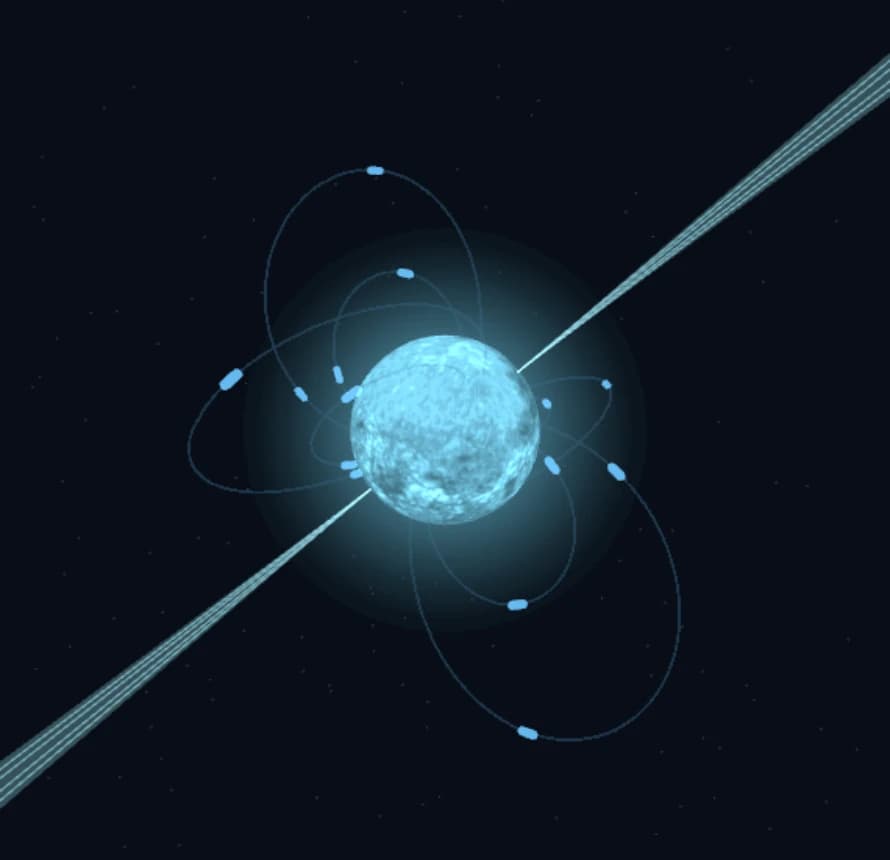 CAPTURED IN TUDUNI LABORATORY
THE PHYSICS
A closer look.
The dipole field falls with the cube of distance and rotates with the source.
B = μ₀(3n(m·n) − m)/(4πr³)
G is the gravitational constant, M and m are masses, r is separation, c is the speed of light, and b is impact parameter where applicable.
What you can learn
- Compare spin and magnetic axes
- Toggle magnetic fields and radiation cones
- Inspect physical radius, field strength and rotation
Default bodies
1.4 solar masses, 12 km radius, 1 second rotation, representative 10⁸ T polar field
CAPTURED IN TUDUNI LABORATORYIllustrative surface and radiation cones. Flat-space vacuum near-zone dipoles and Newtonian motion; no relativistic plasma magnetosphere.
Space fabric illustrates gravitational influence; it is not a numerical solution of the full Einstein field equations. Visual sizes can be enlarged independently of physical collision radii.