Explore the known universe
Travel from the Local Group to distant quasars. Visit galaxies, famous black holes, rare stars and the Solar System's small bodies.
Launch Simulation ↗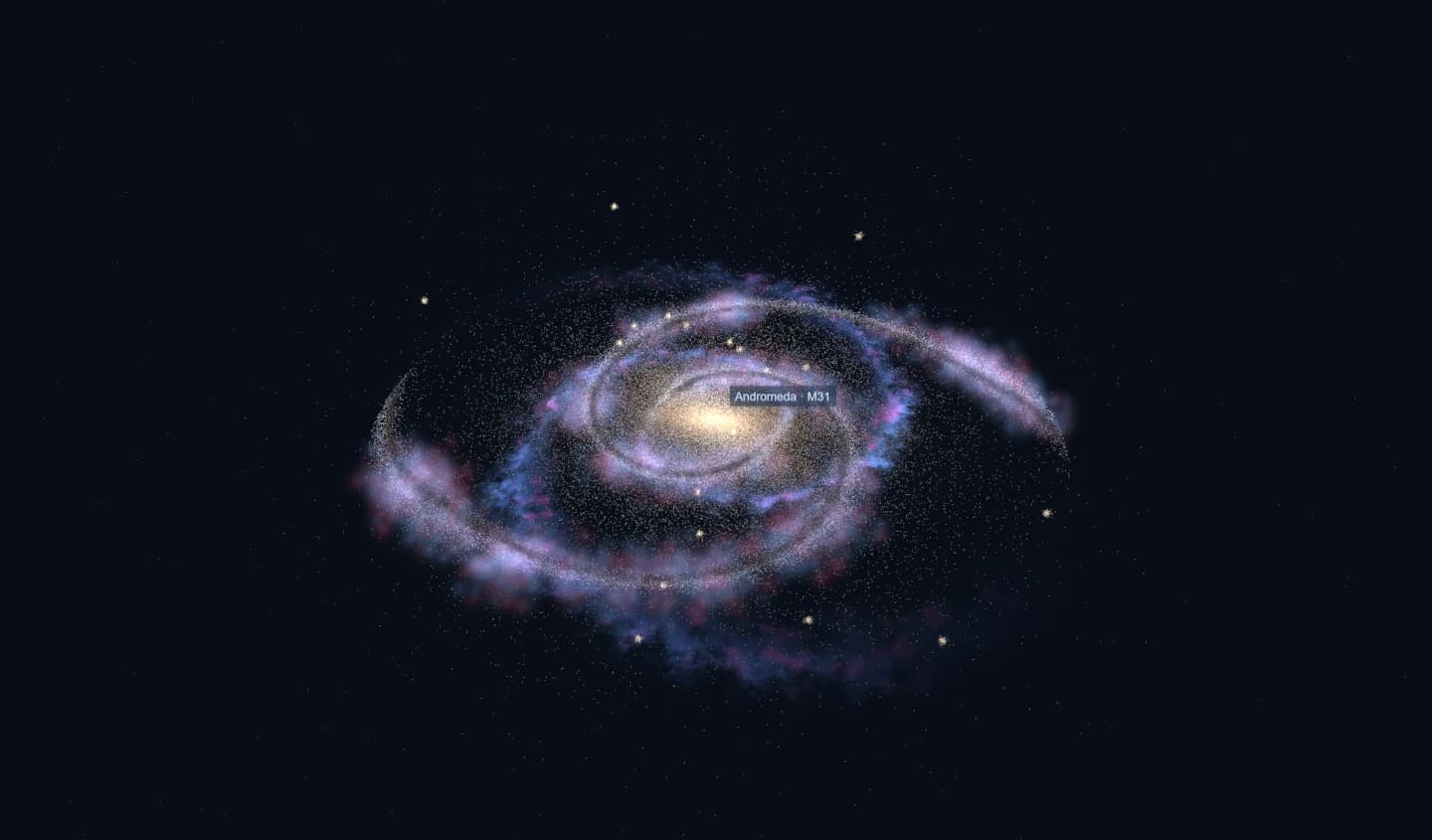 CAPTURED IN TUDUNI LABORATORY
A closer look.
Catalog directions and approximate distances become 3D positions. Navigation changes the local camera scale.
G is the gravitational constant, M and m are masses, r is separation, c is the speed of light, and b is impact parameter where applicable.
What you can learn
- Compare spiral, elliptical and irregular galaxies
- Visit the hosts of Sagittarius A*, M87* and R136a1
- Explore inclined comet orbits and the asteroid belt
- Understand local versus cosmological distance scales
Default bodies
24 curated destinations, 3 named comets, Ceres, 3 asteroids and an illustrative asteroid belt
CAPTURED IN TUDUNI LABORATORYA curated atlas, not a complete universe survey or live ephemeris. SIMBAD J2000 directions, rounded source distances and flat-LCDM radial comoving distances for quasars and GN-z11. Shapes, orientations, colors and close-ups are illustrative. Catalog entries are outside the N-body solver; comet phases are illustrative.
Space fabric illustrates gravitational influence; it is not a numerical solution of the full Einstein field equations. Visual sizes can be enlarged independently of physical collision radii.