 CAPTURED IN TUDUNI LABORATORY
AT THE EDGE OF A HORIZON
A different view of light.
Explore a Schwarzschild black-hole shadow, a glowing accretion disk, and light traced through the surrounding geometry.
Explore the black holeOpening your Tuduni experience…
Experiment with gravity. Follow satellites around Earth. Observe the sky from another world. Turn your discoveries into cinematic stories.
Build an experiment, follow an orbit, look up from another world, and create a story to share.
Experiment with gravity, celestial motion, space fabric and black-hole lensing.
Open Tuduni Laboratory ↗02Follow real cataloged comets and asteroids through past and predicted future time.
Open Solar System Explorer ↗03Follow catalog orbits, compare ground tracks and inspect sourced spacecraft models.
Open Satellite Explorer ↗04Explore calculated celestial positions from an Earth or lunar observer.
Open Sky Observatory ↗05Rehearse, frame and record space-science stories in MP4, MOV or WebM.
Open Video Studio ↗Search the ISS, a navigation satellite or a constellation. Compare LEO, MEO and GEO, follow one spacecraft, and inspect an official, approximate or generic model with visible provenance.
Explore Satellites ↗Explore an Earth horizon with your location and time. Then stand on the Moon, look for Earth and discover why its motion there follows libration.
Open the existing NASA Live Moon experience ↗Selected NASA ISS, Hubble and Landsat models provide published spacecraft references. Navigation and communications models use clearly labelled generic components when verified assets are unavailable.
Follow real comets and asteroids, rewind historic encounters, and explore predicted future trajectories using NASA/JPL orbital data.
Explore the Solar System ↗These are captures from the simulator.
Open the scene and change the conditions yourself.
CAPTURED IN TUDUNI LABORATORYExplore a Schwarzschild black-hole shadow, a glowing accretion disk, and light traced through the surrounding geometry.
Explore the black hole CAPTURED IN TUDUNI LABORATORY
Compare reference paths with weak-field light deflection near a stellar lens. Visual amplification helps you see a subtle effect.
Explore light bendingGravity is everywhere.
Now you can explore it.
Where is the Moon from where you are? Compare its live position around Earth with the direction, altitude and illuminated face in your local sky.
Device location is requested when you press Use my location in the Live Moon view.
 CAPTURED IN TUDUNI LABORATORY
Travel from the Local Group to distant quasars. Visit galaxies, famous black holes, rare stars and the Solar System's small bodies.
 CAPTURED IN TUDUNI LABORATORY
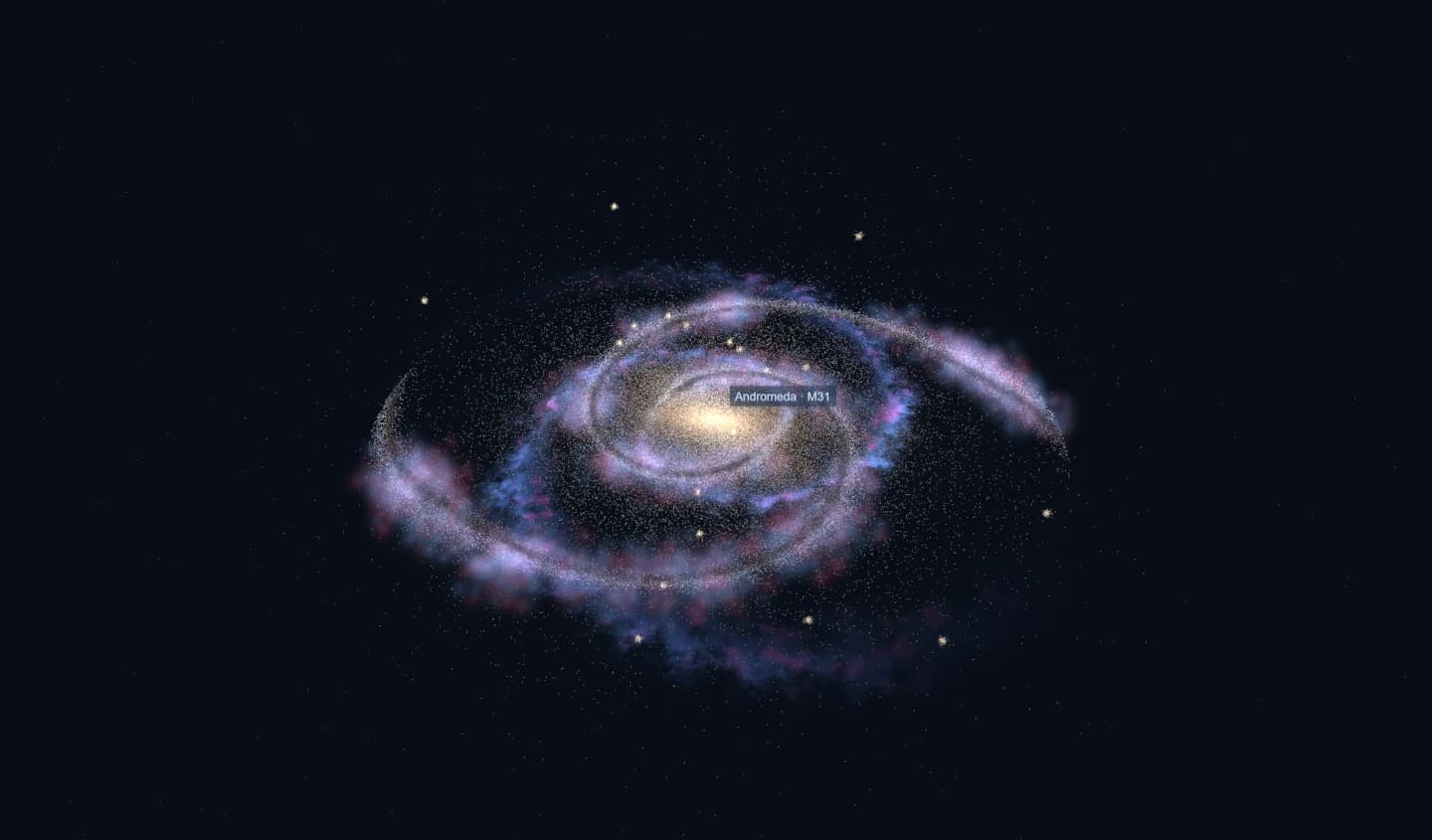
Fly through a detailed 3D barred spiral: a warm stellar bulge, winding arms, dust lanes and star-forming clouds.
 CAPTURED IN TUDUNI LABORATORY
A familiar world. A quiet companion. An orbit held together by gravity.
Follow a moon around a planet while both travel around their star.
Two stars. One shared center. A gravitational conversation without an end.
Small changes. Vastly different futures. Explore a universe with no simple script.
A precise toolkit for exploring celestial motion
and creating visuals that explain the invisible.
Real-time mutual N-body forces, editable mass and velocity, and conservation diagnostics.
Explore volumetric grids, suspended dust, directional dashes and transparent plasma.
Compare weak-field light bending with Schwarzschild null-geodesic lensing.
Create planets, stars and moons. Drag their names, shape their orbits and test a hypothesis.
Work in SI units. Inspect equations, tune integration and understand model limitations.
Save versioned projects and capture browser video in creator-friendly aspect ratios.
Begin with a lunar orbit, a binary star or the edge of a black hole.
Change bodies, forces and the way you see the gravitational field.
Follow the result, save your work and record a visual story.
Teach a concept. Test a prediction. Create a visual.
Start with a question, then give it a scene.
Put a moving model on the classroom screen. Ask students to predict the result, change one variable, then explain what they observe.
THREE IDEAS TO GET YOU STARTEDCapture your own visual explanation for a science video, a short, or a documentary segment. Frame the scene, choose an aspect ratio, and record in the browser.
THREE IDEAS TO GET YOU STARTEDBuild intuition by changing a single condition. Watch the motion, inspect the numbers, and save different versions to compare your experiments.
THREE IDEAS TO GET YOU STARTEDUse the laboratory in a club session, a livestream, or an astronomy workshop. Move from a familiar lunar orbit to an unfamiliar view near a horizon.
THREE IDEAS TO GET YOU STARTEDExplore compositions for presentations, exhibits, and science-inspired creative work. Adjust the camera and field styles, then capture a sequence that fits your story.
THREE IDEAS TO GET YOU STARTEDExplain gravitational influence with field views and light trajectories. Compare the visuals with the equations and clearly identify the model's limits.
THREE IDEAS TO GET YOU STARTEDDesigned for learning, exploration and visual storytelling. Simplified models and illustrative field views are explained inside the laboratory.
Your first experiments, on us.
5 user-created bodies · 720p capture
Up to 15 seconds per recording
For stories that make science clear.
30 user-created bodies · 1080p capture
Up to 300 seconds per recording
For ambitious visual explorations.
100 total bodies, subject to device performance · 2160p capture
Up to 600 seconds per recording